
In Part 2, we explained what went wrong with our first concept: an electric heater placed above a conventional ceramic bowl.
We have heard that others in the industry have made this approach work, and we acknowledge that. Having worked through the challenges ourselves, we respect the engineering effort involved. Our experience reflects the limits of our own first design. It is not a conclusion that this approach cannot succeed.
The next step was deciding what those problems meant for our design. Which assumptions did we need to abandon? Which lessons could we carry forward?
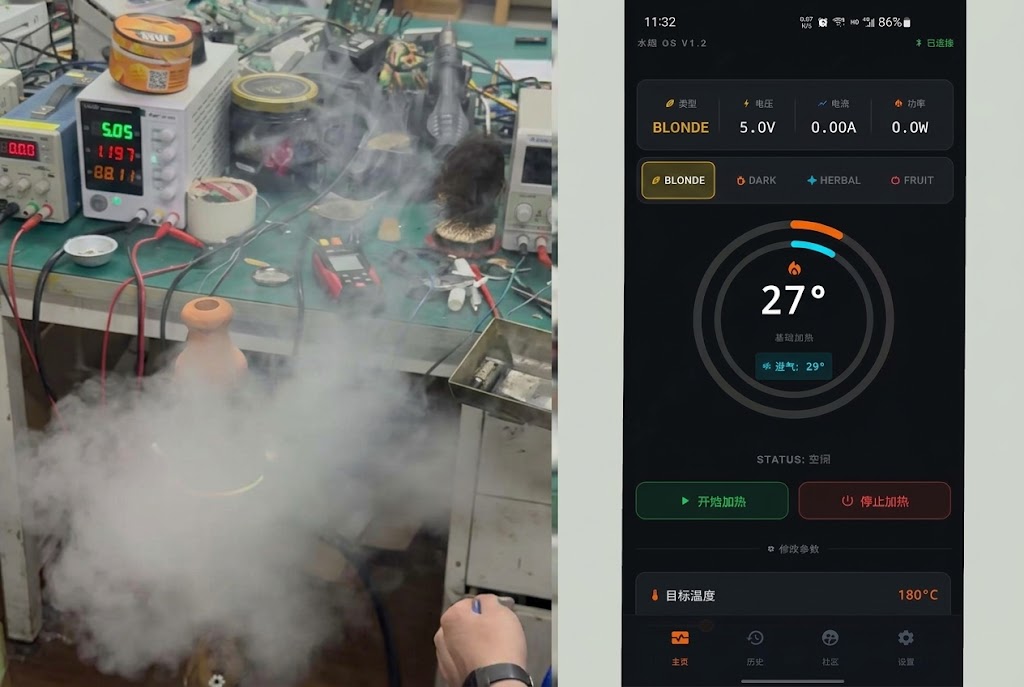
What we dropped: the original heating assumption
Our starting assumption was straightforward: place an electric heater where the charcoal normally sits, and reproduce its heating effect.
Testing exposed two problems in our implementation.
The first was sealing. The interface between the upper heater and the ceramic bowl needed more attention than our original concept allowed.
The second became clear during repeated draws: the system could not maintain the heat supply.
As successive draws carried heat away from the ceramic bowl, the stored heat was depleted and the tobacco temperature fell. The temperature of the hot air supplied from above also dropped. Vapor output and the experience deteriorated with it.
This changed how we evaluated the design. Reaching an initial operating temperature was only one requirement. We also needed to maintain the thermal conditions during continued use.
What we kept: airflow heating and practical knowledge
The first prototype gave us useful evidence for the next design.
Heating the airflow remained a viable approach. Our tests supported carrying that principle forward, with a different arrangement for heating and maintaining the bowl temperature.
We also developed a practical understanding of how the tobacco responded to heat. Testing helped us understand the relationship between the temperature at the bowl’s base, the incoming air temperature, and the resulting experience.
Those observations gave us a better basis for making design decisions than our initial assumptions alone.
Materials were another important lesson. Working with real prototypes helped us identify which materials were suitable for the application and which were not. That knowledge carried directly into the redesign.
The principles that guided the next version
From this review, we established four priorities.
1. Give bowl heating and air heating distinct roles.
The lower section would hold the tobacco bowl, with a ceramic heating element providing heat and helping maintain its temperature. The upper section would contain the air-heating chamber.
A magnetic connection between the two sections would make them easier to separate, allowing lounge staff to replace or replenish the tobacco during service.
This arrangement addressed both the thermal problem and a practical handling requirement.
2. Improve the housing’s material quality and finish.
We chose aluminum alloy for the upper housing to give the product the quality and feel we wanted.
That choice also had to work alongside another requirement: controlling the temperature of surfaces people could touch.
3. Make exterior temperature a design constraint.
The device needed high temperatures internally, while its accessible exterior surfaces needed to remain cool enough to handle.
Reducing the chance of a burn from the housing became an explicit requirement for the new design, alongside heating performance.
4. Account for accidental cable pulls.
A power cable can be caught or pulled during service. We chose a magnetic cable connection intended to release under an accidental pull, reducing the chance of dragging the device off its resting surface.
It was a small connection detail with a clear role in everyday use.
What the first version gave us
By the end of this review, we had a clearer set of requirements: maintain heat during repeated draws, make tobacco changes easier for staff, improve the housing, and account for handling risks.
The first prototype had helped us define those requirements through experience. They became the foundation for the next version.
Next
In Part 4, we will explain how these lessons came together in the redesigned heating architecture.